James Patrick Crisp
Contemporary Wood Sculpture
Since 2011

‘Immaterial II’, James Crisp Sculptor, Carved Wood Panel in English Lacewood with Rippled Sycamore disc, 2023, 1m x 0.7m
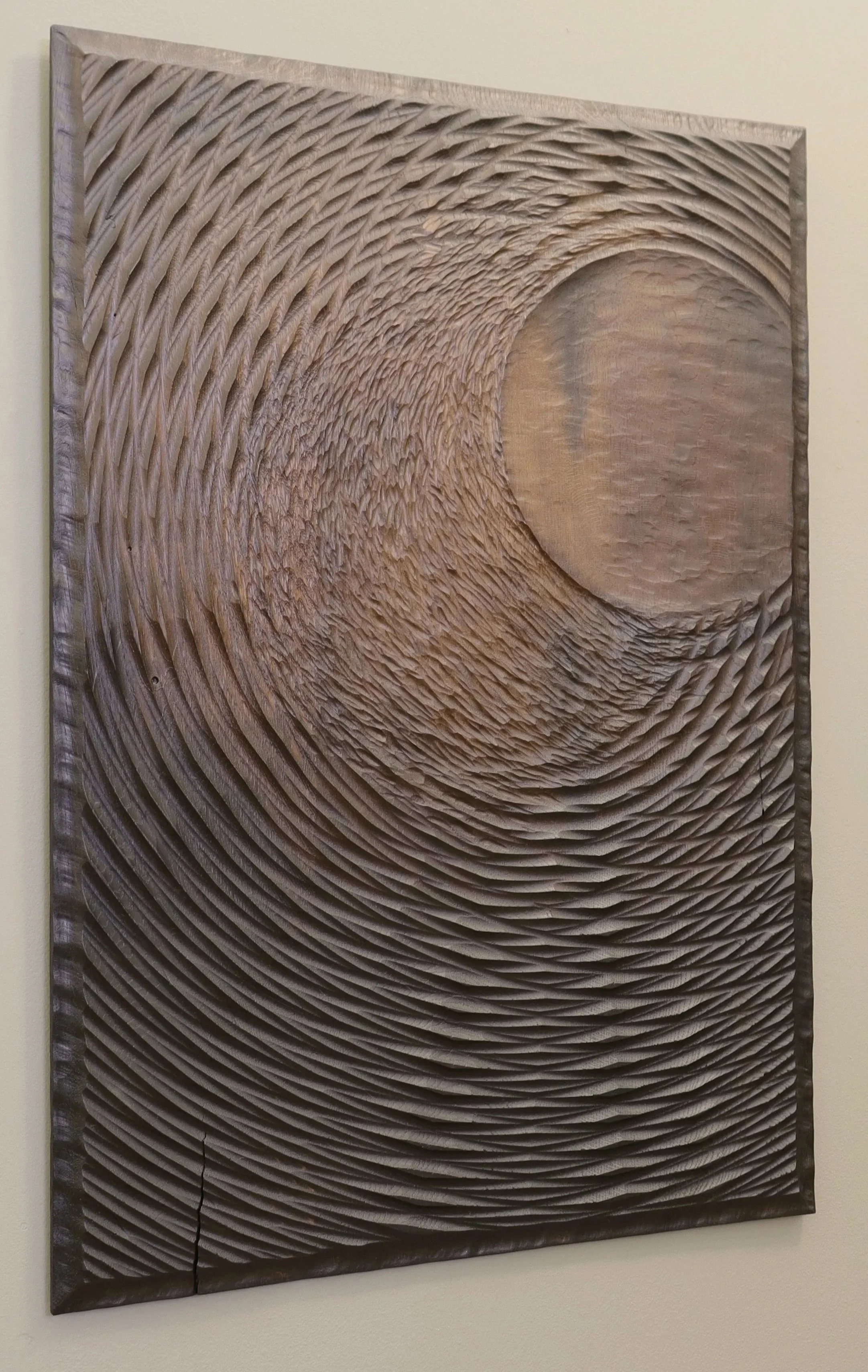
‘Tides’, James Crisp Sculptor, 2025, Carved Wood Panel in English Oak, 1m x 0.7m.

‘Far Shore’, James Crisp Sculptor, 2016. Carved Wood Panel in English Quartered Oak, 1.1m x 0.9m

‘Mandala VI’, james crisp sculptor, 2021. An example of my ‘geometric interference’ style. This is an unmodified photograph of a carved wood surface, carved with a powered handheld tool with blades, guided by set curves. There’s no computer design or making. This view is from close at a shallow angle, with window reflection.
Why would sets of overlapping circles create straight lines, radiating from a centre?
How does a simple repeated process create infinite variation?
My work comes out of meditations on wave interference, fractal geometry and emergent complexity- chaos, balance and order.
Yet it's instinctive- the conceptual specifics are often realised later, it's about an emergent process.
The other side is wood as a medium- exploring its’ forms and developing a practice for using it to create images. Wood is both sacred and full of information, as a once-living material, so it inherently speaks of natures’ patterns and processes. Viewing it is like a forensic yet sensual dive into nature and history, telling of its’ life, and all life.
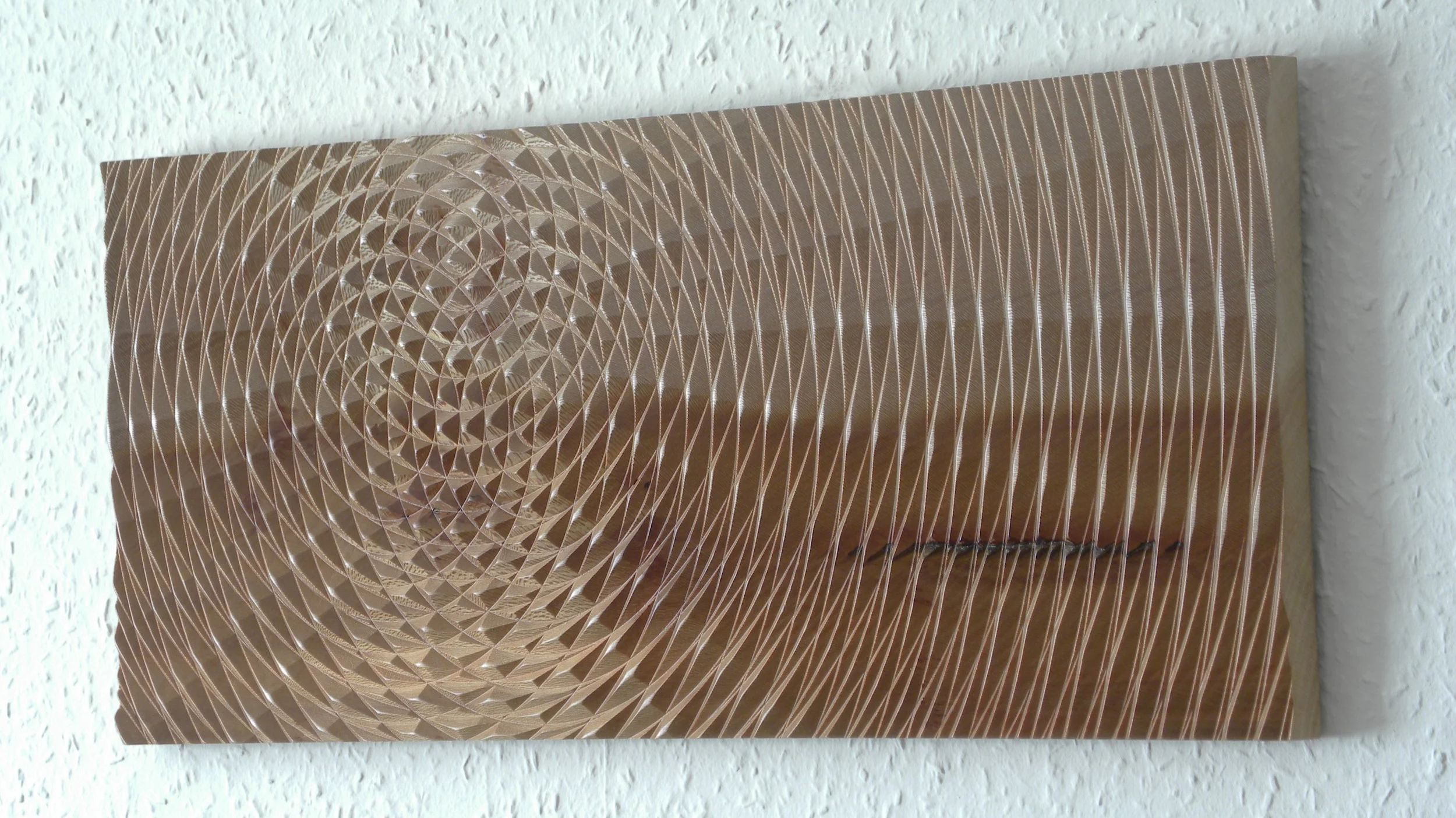
James Crisp Sculptor, ‘Interference III’, 2011, Carved Plane Wood- an early example of my geometric interference style, produced using my unique, personally developed techniques.
I work mainly to commission and sometimes have speculative pieces for sale, artworks are available for delivery worldwide.
Follow this link for an example of my work for world leading art consultants, Artelier, and Rosewood Hotels.
https://www.artelier.com/post/artelier-curation-rosewood-miyakojima-japan
https://www.rosewoodhotels.com/en/miyakojima/overview/gallery#rooms

james crisp sculptor- a wilder feel in geometric interference patterns. Detail shot, again unmodified, taken of a carved lacewood piece from 2023.
Before I developed my unique woodcarving style, I worked in varied roles, mostly in bespoke cabinetmaking and construction, learning traditional and modern woodworking skills, carving, antique restoration, wood finishing and guitar making. Since 2021 I have turned full time to artistic wood carving.
I studied Art from sixteen to eighteen in Cambridge, England- this had been my main focus and intention for the future whilst growing up. My tutor suggested Kings College London, where he had connections. He and others in the department loved my paintings but disliked my mysticism and attitude. I left and had a great few years working in construction, then moved from that into various skilled woodworking positions, but I never abandoned art. I knew that my long term desire to produce unique sculptural forms and progressive musical instruments, and also to work directly (to design and make, as an individual, rather than as a company, or as designer only), would require a wide and diverse set of skills.
The precision, form and detail I achieve has often led people to ask if my work is done with computer guided machine carving- it is not, and for my works there is no computer aided design either. In my ‘geometric interference’ style, handheld electrically driven tools are guided by geometry (like drawing with a ruler or compasses), but traditional handwork techniques are critical.
When I started doing abstract relief carvings to hang on walls, the concept was relatively uncommon, and my specific style was unique- it still is. I gained a lot of interest online around 2013 and sold well internationally before much exposure at home. Abstract carved relief surfaces have since then become a defining high end interiors style of our period (I have artworks on display on three recently constructed mega yachts that also contain artworks, walls and furniture in this style, plus private collections and varied commercial spaces worldwide).
In 2011, programming a machine to do bespoke carving work was impossibly expensive outside of mass production, and I didn’t want to go that route personally anyway. Having computers create designs for art objects largely independently was science fiction. Programs for computer carving machines were not sold online on sites advertised as ‘markets for small independent makers’. That's not the case now in 2026. I don’t want to appear dismissive of other working methods- I love computers and so much of the opportunities and artforms that they have enabled, but I think this new technological situation calls us to remember the strengths and value we have because we are corporeal and embodied, and that the same can apply to our art. I believe working directly by hand has an inherent value and can be more precise in practice, whether its guided, like a wood plane creating a flat surface (which is essentially the same as a handheld power carver following a set curve), or totally freehand with one of my 19th century hand forged carving gouges or a violin knife.
Traditional sculpture and woodwork skills are critical for my work, even in those pieces where the form is created largely by geometrically guided handheld powered carving tools. I sharpen the tungsten carbide cutting tips of my electrically driven carving blades with the same attention as I do my japanese white paper steel laminated chisels.

Rotary carving blade with tungsten carbide cutting tips, old japanese chisel with ebony handle, old english no4 gouge with boxwood carver handle, on dyed english walnut ‘geometric interference’ style carving.
Every picture you see on this site is an image of a real object, even the strange abstracted detail shots. There is no use of AI to create images of apparently real items that have never existed to make only on demand.
I work from North Norfolk in eastern England, a few miles from the sea and the Norfolk Coast National Landscape and Scolt Head, in converted buildings on a former military airbase that’s five minutes from my home just outside a medieval English village. The old airbase site has some brutalist architectural jems, plus real biodiversity, in the areas that are decades untouched by management. My timber comes from English forests and fields, some right on my doorstep.
James Crisp 2026

The view round the side from my studio- I dont work in there! Awesome but cold and windswept.
An example of my work for world leading art consultants, Artelier, and Rosewood Hotels.
https://www.artelier.com/post/artelier-curation-rosewood-miyakojima-japan
https://www.rosewoodhotels.com/en/miyakojima/overview/gallery#rooms

works in progress, jamescrispsculptor.com
Above- Works in progress for the Rosewood Miyakojima Hotel project, shown completed below. The semi-figurative bust was a new direction for me at the time. I was asked to do one on commission. More are coming. It was made during a time when I was watching a close friend slowly die of a painful spinal condition, though it took a while for me to realise the influence. Rest in Peace Ali.

‘Tension Bust’, Oak, 2024, james crisp sculptor.

‘Balance Discs’ Oak, 2024, James Crisp Sculptor, 2.1m high. There’s a lot of hidden stainless steel that reinforces this sculpture- it’s outside now on a Japanese Island.

in my studio 2021, jamescrispsculptor.com
Contact
Email. james@jamescrispsculptor.com
Email. james@halflightguitars.com
Phone. +44 (0) 7599 873 199
Workshop address
Unit F, Building 7, West Raynham Business Park, Norfolk, England, NR21 7PL
All images and text on this site are copyright James Patrick Crisp